The Cognitive Cost of Convenience
Why making work look easy is making us worse at our jobs.
AI “slop” has officially taken over the digital landscape. It fills our feeds with low-quality, low-effort text, synthetic images and generic video, mass-produced by generative models. On the surface, this looks like a problem of aesthetics, too much noise, not enough signal. Beneath it sits a quieter, more dangerous crisis: the erosion of critical thinking at work.
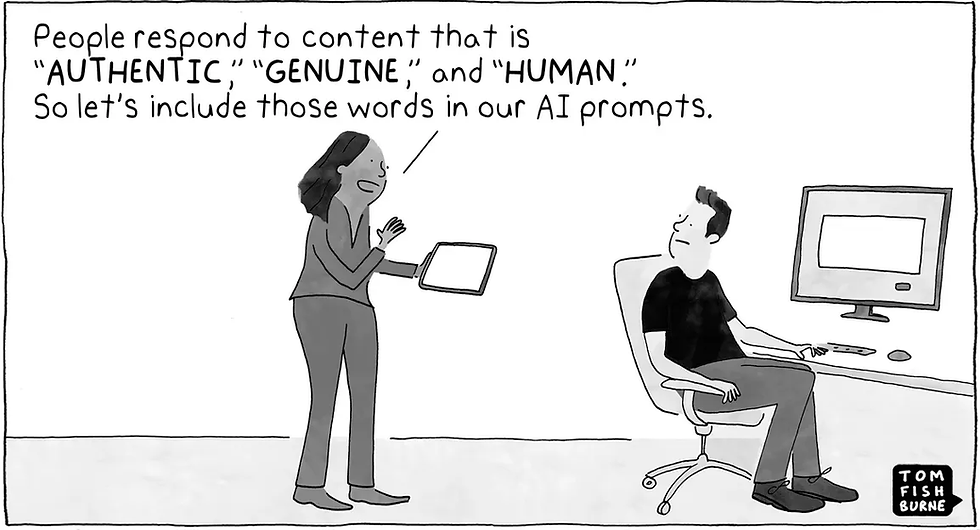
Cartoon: Tom Fishburne
AI itself isn’t the problem. Our reckless dependence on it is. By making output feel effortless, it tricks people into skipping the actual labour of thinking something through properly. Too many professionals now believe a two-sentence prompt can produce work worth their salary. What they don’t realise is that the systems they’re leaning on are quietly deteriorating from the inside.
The Inbreeding of Mind and Model
In computer science, a phenomenon known as model collapse, or “Habsburg AI”, occurs when newer models are recursively trained on data generated by older AI, rather than on original human work. Like biological inbreeding, this closes the loop and restricts diversity. Over time, outputs degrade, errors compound, and the system starts producing polished nonsense.
There’s a separate trend worth putting on the table here, and I want to be careful not to overclaim it. For more than a century, global IQ scores climbed steadily, a pattern known as the Flynn effect. Recent data suggests it’s stalling, and in some places reversing. This isn’t a claim about AI causing that decline; the research predates generative AI by decades. But it’s a useful backdrop. Something in human cognition may already have been plateauing before any of us had touched a chatbot. Outsourcing more of our thinking to machines now is unlikely to reverse that on its own.
The Power of Not Knowing
What actually separates a good professional’s thinking from predictive text? The capacity to start from Not Knowing.
AI can’t sit in a state of blank potential. It can only calculate the next most probable word, based on what’s already been said. It has no access to silence. Consider Einstein’s own reflection on how he worked:
“I think 99 times and find nothing. I then stop thinking, swim in silence, and the truth comes to me.”
AI can never swim in silence. It can’t experience the friction that turns confusion into a breakthrough, and that friction is where the judgement clients and employers actually pay for gets built. This is why a rough, human-drawn stick-figure animation can feel more compelling than a technically flawless AI-generated short. The stick figure carries intent, born out of a genuine struggle to say something. Polished output with no struggle behind it tends to feel hollow, even when it’s competent.
Critical thinking and creativity still have the power to surprise you precisely because they sit outside the training data, outside the very distribution the slop is made from. That's what makes humans irreplaceable.
Using AI Without Losing the Plot
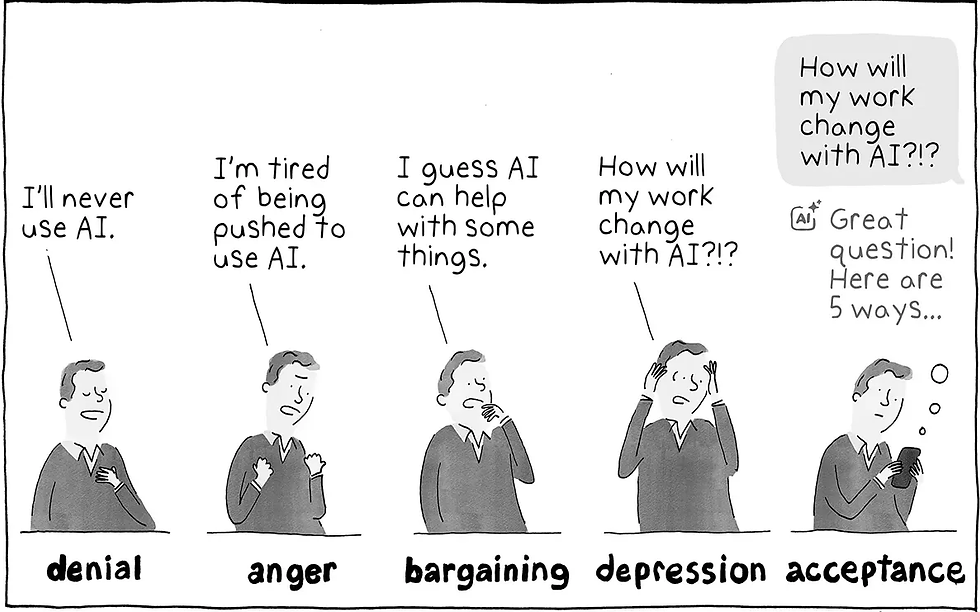
Cartoon: Tom Fishburne
None of this is an argument for avoiding AI. It’s an argument for keeping your hands on the wheel while you use it.
The professionals getting real value from AI aren’t the ones prompting first and thinking later. They’re the ones who think first, then bring AI in to execute faster. Before you open a prompt window, you need to already understand how the pieces of the problem fit together, and have a clear view of what “good work” looks like at the end. AI is there to remove the friction of execution, not the friction of thought, and only one of those frictions is worth skipping.
In practice, that means building your own structure first. Draft your own framework, argument, analysis or recommendation before you hand it to a model. Use AI to tighten, refine and pressure-test what you’ve already built, not to generate the thinking from scratch.
A junior who works this way builds real judgement over time. One who skips straight to the prompt never builds it at all, and it shows the moment someone asks a follow-up question on their work.
You can’t leverage a tool you haven’t earned the right to use. Critique your own ideas first. Struggle with the problem before you hand it over. If you don’t fight to articulate your own thinking, you aren’t using AI to work more efficiently, you’re just adding your name to the slop.


Comments